---
title: "Real-Time Features in MVPs: WebSockets vs SSE vs Polling"
description: "Explore how to integrate real-time features in MVPs using WebSockets, SSE, or Polling, and choose the best fit for your needs."
pubDate: "2026-05-16"
author: "Aman Jha"
image: ""
ogImage: ""
template: "comparison"
tags: ["MVP Development","Real-Time Features","WebSockets","SSE","Polling"]
keywords: ["real-time features in MVPs","WebSockets vs SSE vs Polling","integrating real-time features in MVPs","real-time updates for MVPs","enhancing MVPs with real-time capabilities","choosing real-time technology for MVPs"]
targetICP: "wall-hitter"
draft: false
faq:
  - question: "What are the differences between WebSockets, SSE, and Polling?"
    answer: "WebSockets support full-duplex data flow between client and server. SSE pushes server updates one-way. Polling periodically fetches updates. Each has pros and cons based on app needs."
  - question: "How do I integrate real-time updates into my MVP?"
    answer: "Pick a technology (WebSockets, SSE, or Polling) that fits your data flow. Set up server endpoints to send or broadcast updates. Then ensure your MVP's front end handles those updates in real time."
  - question: "Why are real-time features important in MVPs?"
    answer: "They boost engagement and retention. Users expect instant feedback and updates, which can set your MVP apart from slow-moving competitors."
  - question: "What is the best real-time technology for my MVP?"
    answer: "Depends on your exact use case. Two-way communication needs WebSockets. One-way updates lean toward SSE. If your app only needs intermittent data, Polling might suffice."
  - question: "Can I use multiple real-time technologies in one MVP?"
    answer: "Yes, it's possible. Combining solutions can be helpful if different sections of your MVP have distinct requirements. Just watch your resource usage."
---
## The Real Question: Why Real-Time Features Matter in MVPs

"Real-time features in MVPs" sounds fancy, but they're like magic in action. Many founders have experienced challenges with MVPs that lack real-time features. No instant feedback, no live updates—just flat. Users left, and many never came back. Industry data suggests real-time updates can amp up user engagement significantly in early-stage products. That's a game-changer when your runway is short.


<figure>
  <img src="/blog/inline/how-to-add-real-time-features-to-your-mvp-websock/fig-01-framework.png" alt="The core framework" />
  <figcaption>The core framework</figcaption>
</figure>

I've witnessed the power of real-time updates myself. Alerts popping up, status bars changing in seconds. It’s the difference between a user who keeps an app open all day versus one who bails in 30 seconds. MVP stands for Minimum Viable Product, but that "minimum" rises every year. Skipping real-time? That’s a surefire way to see user churn.

Sure, you can tweak later, but investing in instant data flow now can pay off big time when you expand. For more insights on iterating MVPs, check out my piece on the [importance of iterating MVPs](/blog/importance-of-mvp-iteration). People want live data—be it chat notifications or stock moves. Real-time features are often the make-or-break factor between "nice try" and "take my money."

[INLINE IMAGE: data-viz — A graph showing increased user engagement with real-time features]

## The Math: Comparing WebSockets, SSE, and Polling

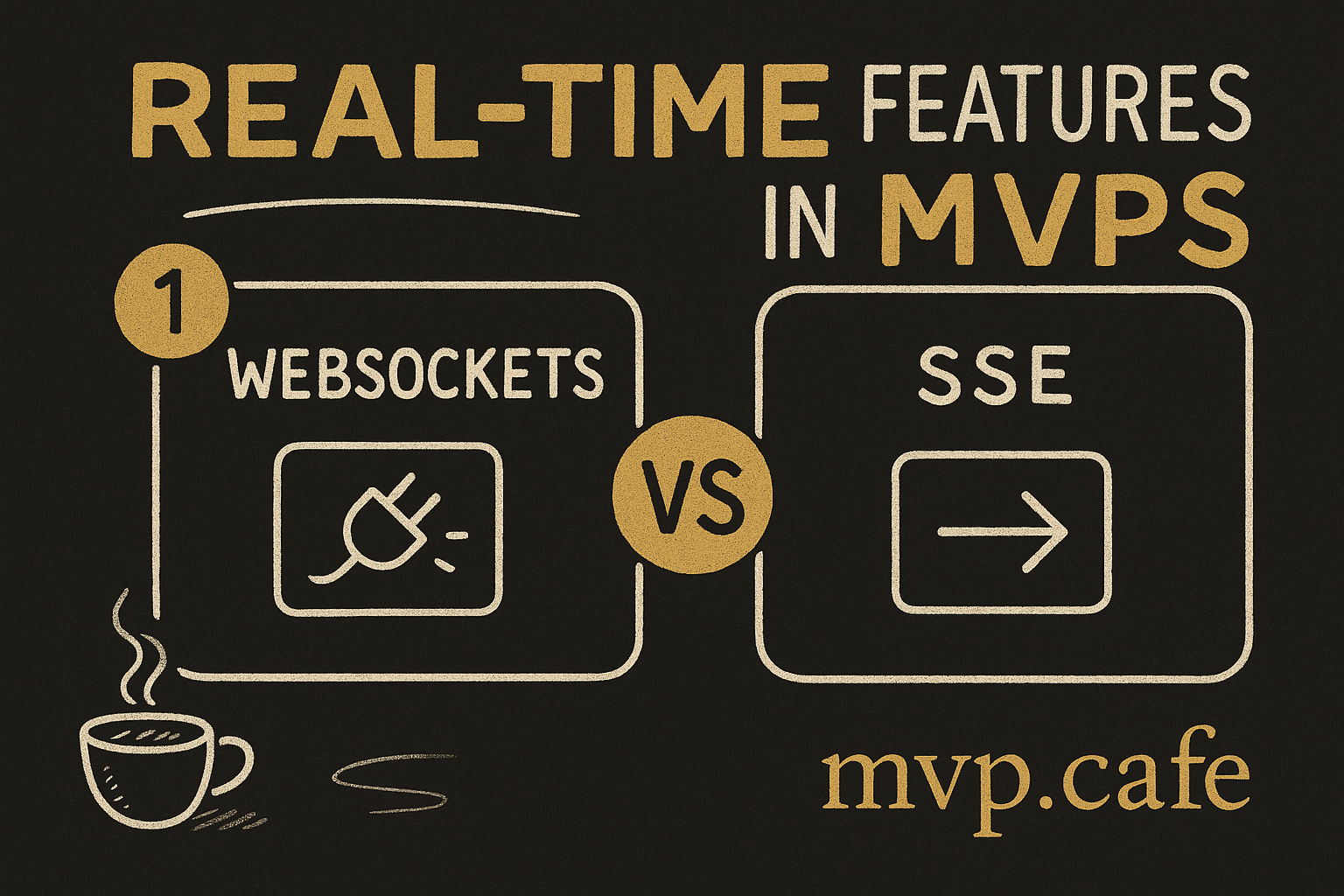
Let's dive into the three big players for real-time data: WebSockets, SSE, and Polling. Each has its quirks. I've played with all three over the last decade, and the numbers tell an interesting story.


<figure>
  <img src="/blog/inline/how-to-add-real-time-features-to-your-mvp-websock/fig-02-failure-modes.png" alt="Common failure modes" />
  <figcaption>Common failure modes</figcaption>
</figure>

- **WebSockets**: These maintain a consistent, bidirectional link between client and server. Latency can be under 50ms in solid networks. Push or pull data anytime. It’s like an open phone line. But, hosting costs can shoot up if you can't handle concurrent connections well.

- **Server-Sent Events (SSE)**: The server keeps an open channel to the client but only streams data one way. Perfect for "broadcasting" rather than "chatting." Resource use is often lower as the server does the heavy lifting. Scaling can be tricky with 200K+ connections, but for small MVPs, SSE can be ideal.

- **Polling**: The old-school method. The client nudges the server every X seconds for updates. Easy to code, but can overwhelm your backend if you scale. Polling works if updates aren’t frequent or mission-critical. But in 2026, it feels a bit outdated for continuous streams.

Performance metrics vary, but industry data suggests WebSockets handle high throughput better when you cross 1,000 simultaneous users (source: launchconsulting.com). Polling becomes a bandwidth hog fast. SSE sits in the middle, with less overhead than polling but not as flexible as WebSockets. Depending on your budget, each approach can cost between ₹8,000 to ₹20,000 monthly in hosting if you're dealing with thousands of daily active users. That's a rough estimate. Actual costs depend on your architecture and update frequency.


## When WebSockets Win: Use Cases and Benefits

WebSockets are unbeatable for constant back-and-forth. Real-time gaming is the go-to example. Think of a chess app with thousands of matches running simultaneously. Every move must broadcast instantly. Polling? It would collapse. SSE? It handles only half the conversation. WebSockets thrive in two-way chatter.


<figure>
  <img src="/blog/inline/how-to-add-real-time-features-to-your-mvp-websock/fig-03-before-after.png" alt="Before vs after" />
  <figcaption>Before vs after</figcaption>
</figure>

Live collaboration is another case. At the [GoMechanic project](/case-studies/gomechanic), we considered WebSockets for real-time membership tracking. When a user redeemed a coupon, the system pinged others with updated counts. Two-way data flow. The result? A 200% membership boost in under a year as people stayed engaged, not waiting for page refreshes.

WebSockets need a server (like Node.js or Go) to handle persistent connections. You might need a message broker like Redis for event-heavy environments. But if your MVP relies on interactive elements—chat apps, real-time dashboards, or multiplayer tasks—WebSockets rarely let you down.


## When SSE Shines: Ideal Scenarios and Advantages

Server-Sent Events (SSE) is the go-to if your MVP mainly sends updates from server to client. I've seen SSE in real-time news feeds, stock tickers, and event notifications. It’s not chatty like WebSockets. But that’s the point. If you need to simply push new data—like a live scoreboard for a cricket match—SSE is straightforward.


<figure>
  <img src="/blog/inline/how-to-add-real-time-features-to-your-mvp-websock/fig-04-checklist.png" alt="Action checklist" />
  <figcaption>Action checklist</figcaption>
</figure>

It doesn’t require the overhead of a two-way pipeline. If the connection drops, the client can reconnect automatically. SSE uses pure HTTP, making it easy to integrate without extra libraries. If your MVP is on a tight timeline, SSE can be set up in under 2 days by a small dev team (from my experience).

Sure, you lose two-way communication. If real-time user feedback is a must, SSE might fall short. But for unidirectional data, it's more efficient than Polling or WebSockets. If your MVP’s updates are frequent but server-driven, SSE can keep user sessions fresh without sapping server resources.


## Polling: Still Relevant?

Polling? It's the straightforward “Hey server, anything new?” method. Some local government websites in India used it to update election counts every 30 seconds. It’s not dead. Sometimes, you just need updates every 5 or 10 seconds. No need for instant reactivity. Polling is trivial to implement in many frameworks.

But it can be wasteful. If your MVP handles 5,000 concurrent users and each pings every second, you’re burning CPU cycles on empty checks. That hikes up hosting costs. Or worse, slows your system for everyone. If new data comes every 60 seconds, SSE might suit you better.

However, it’s easy to scale if you start small. Set a 30-second interval, manage a modest user base, and you’re sorted. Eventually, you might upgrade to SSE or WebSockets if usage spikes. As a fallback for legacy systems, Polling is still relevant. But if your MVP demands instant interactions, you'll outgrow it quickly.


## What I'd Do: Choosing the Right Technology for Your MVP

When choosing the right tech, start with some basics. Do you need two-way communication or just server broadcasts? How critical is ultra-low latency for your MVP? What's the budget for extra hosting or services?

For serious back-and-forth at sub-second speeds, WebSockets are the way to go. If you just need to push server updates, SSE is simpler. If updates are more "check once in a while," Polling might do for now. Sometimes mixing works. Use SSE for most broadcasts and Polling for legacy endpoints that can't handle streams.

Here's my quick decision tree:
- **Two-way + high frequency** → WebSockets.
- **One-way + moderate frequency** → SSE.
- **Periodic checks + low frequency** → Polling.

Need a hand with real-time integration? The [Rescue service](/services/rescue) might be your lifeline. We've helped many MVP owners who were 80% done but froze when real-time became essential. It happens. The real question is: how fast can you pivot before users leave?

[INLINE IMAGE: framework — A decision tree for selecting real-time technology]

---

## FAQ

**Q1: What are the differences between WebSockets, SSE, and Polling?**
WebSockets support full-duplex data flow between client and server. SSE pushes server updates one-way. Polling periodically fetches updates. Each has pros and cons based on app needs.

**Q2: How do I integrate real-time updates into my MVP?**
Pick a technology (WebSockets, SSE, or Polling) that fits your data flow. Set up server endpoints to send or broadcast updates. Then ensure your MVP's front end handles those updates in real time.

**Q3: Why are real-time features important in MVPs?**
They boost engagement and retention. Users expect instant feedback and updates, which can set your MVP apart from slow-moving competitors.

**Q4: What is the best real-time technology for my MVP?**
Depends on your exact use case. Two-way communication needs WebSockets. One-way updates lean toward SSE. If your app only needs intermittent data, Polling might suffice.

**Q5: Can I use multiple real-time technologies in one MVP?**
Yes, it's possible. Combining solutions can be helpful if different sections of your MVP have distinct requirements. Just watch your resource usage.
Frequently Asked Questions
What are the differences between WebSockets, SSE, and Polling?
Provide a concise comparison of these technologies.
How do I integrate real-time updates into my MVP?
Outline the steps and considerations for integration.
Why are real-time features important in MVPs?
Explain the benefits of real-time features for user engagement.
What is the best real-time technology for my MVP?
Guide the reader through a decision process based on their needs.
Can I use multiple real-time technologies in one MVP?
Discuss the feasibility and potential benefits of hybrid approaches.