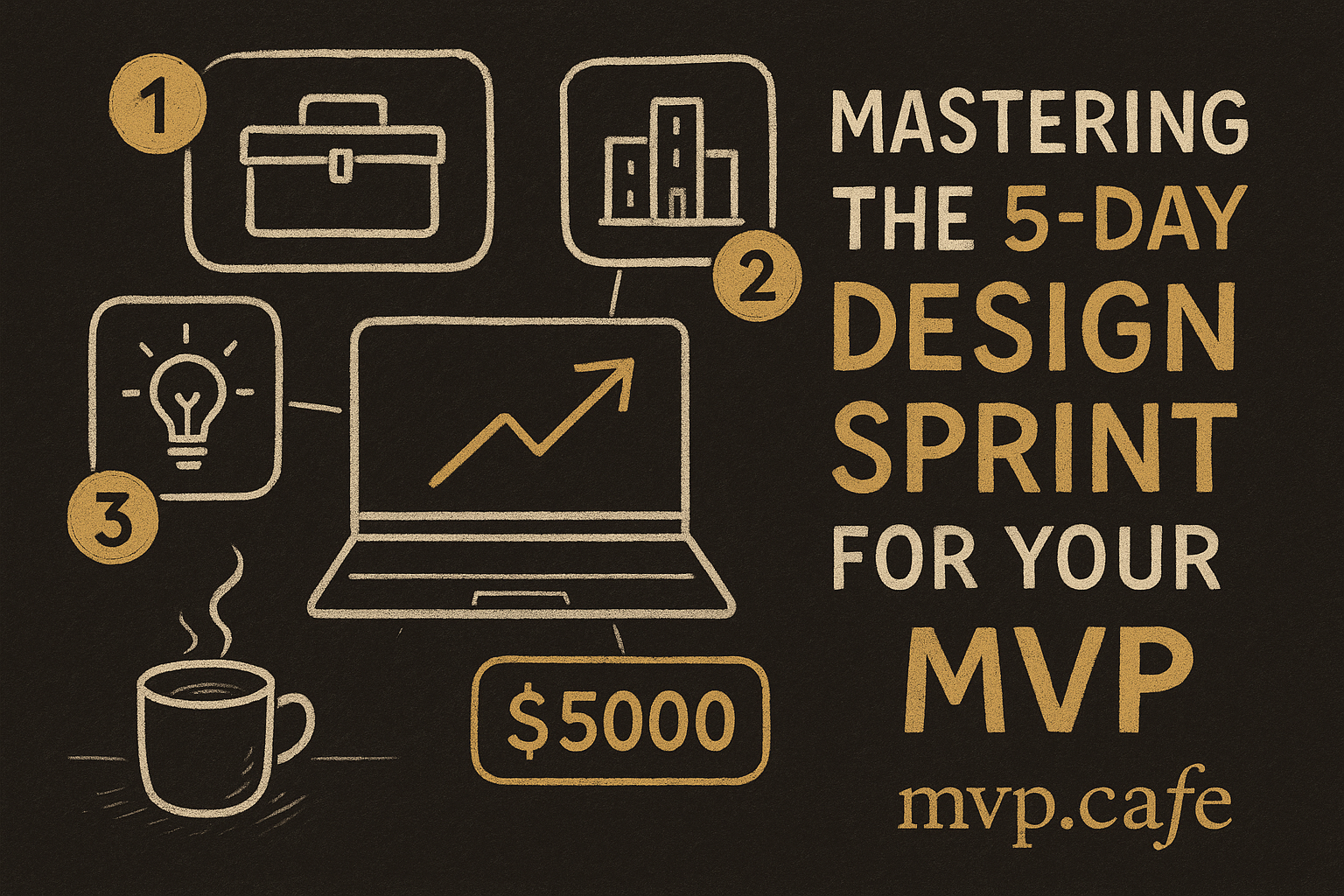
title: "Mastering the 5-Day Design Sprint for Your MVP"
description: "Learn how a 5-day design sprint can accelerate MVP development for solo founders, efficiently validating ideas and attracting early adopters."
pubDate: 2026-05-11
author: Aman Jha
image: "/images/5-day-design-sprint.jpg"
ogImage: "/images/5-day-design-sprint-og.jpg"
template: tool-post
tags: ["design sprint", "MVP development", "solo founders"]
keywords: ["5-day design sprint", "MVP development process", "validate ideas efficiently", "attract early adopters", "strategic guidance for solo founders", "reduce time-to-market"]
targetICP: solo
draft: false
faq:
  - question: "What is a 5-day design sprint?"
    answer: "A 5-day design sprint is a structured process for rapidly prototyping and testing ideas, helping teams validate product concepts efficiently."
  - question: "How can a design sprint help in MVP development?"
    answer: "It accelerates MVP development by providing a clear framework to quickly validate ideas and gather user feedback."
  - question: "What are the steps in a design sprint?"
    answer: "The 5-day process includes setting goals, ideation, decision-making, prototyping, and testing."
  - question: "Why is a design sprint important for solo founders?"
    answer: "It optimizes resources and focuses efforts on critical aspects of product development, crucial for solo founders."
  - question: "What tools are needed for a design sprint?"
    answer: "Essential tools include brainstorming apps, prototyping software, and user testing platforms."
---

## Understanding the 5-Day Design Sprint

Think of a 5-day design sprint as a startup boot camp for your MVP. Google Ventures came up with this, and it crams months of work into a mere week. It's structured, intense, and perfect for solo founders. In just five days, you'll move from having a problem to a tested prototype in hand.


<figure>
  <img src="/blog/inline/how-to-run-a-design-sprint-for-your-mvp-in-5-days/fig-01-framework.png" alt="The core framework" />
  <figcaption>The core framework</figcaption>
</figure>

Here's the breakdown:
**Day 1:** Define your problem and set your goals.
**Day 2:** Dive into brainstorming and sketch solutions.
**Day 3:** Decide on the best ideas and map out the user journey.
**Day 4:** Build your prototype.
**Day 5:** Test it with real users.

For solo founders, the benefits are right there: speed, focus, and clarity. No need for a huge team. Just the right mindset and a few tools. Some folks think it's a magic bullet. It isn't. But it's a powerful tool if used well. Check out [mvp.cafe's expertise](/about) to see how it all fits together.


---

## Day 1: Setting the Stage for Success

Day one is all about preparation. You lay the groundwork by defining a clear goal. What's the problem you're solving? Get specific. There's no room for fuzzy ideas here.


<figure>
  <img src="/blog/inline/how-to-run-a-design-sprint-for-your-mvp-in-5-days/fig-02-failure-modes.png" alt="Common failure modes" />
  <figcaption>Common failure modes</figcaption>
</figure>

Even if you’re flying solo, getting diverse perspectives is crucial. Tap into your network. Use Zoom or Slack to bring in fresh eyes.

Your checklist for Day 1? Setting achievable goals and gathering the essentials. Tools like Trello for tasks or Miro for collaboration work wonders. Strategic guidance is key—it sets the tone for the rest of your sprint. Check out the [strategic planning offered by our Clarity service](/services/clarity) for expert help.


---

## Day 2: Ideation and Sketching

Creativity is in the spotlight on Day 2. Time to brainstorm and generate a flood of ideas. Use methods like mind mapping or SCAMPER to stretch beyond the obvious.


<figure>
  <img src="/blog/inline/how-to-run-a-design-sprint-for-your-mvp-in-5-days/fig-03-before-after.png" alt="Before vs after" />
  <figcaption>Before vs after</figcaption>
</figure>

But don’t stop at just brainstorming. Sketch out those ideas. Get them down visually. It’s not about being an artist; it’s about clarity. Check each idea’s feasibility. Which ones align best with your MVP goals?

Creativity is the lifeblood of your MVP. It’s how you stand out and draw in early adopters. Solo founders often skip this step, but it’s crucial for efficient validation of ideas.


---

## Day 3: Deciding and Storyboarding

Day 3 is all about making decisions. From your idea pool, pick the most promising ones. Consider feasibility, potential impact, and goal alignment.


<figure>
  <img src="/blog/inline/how-to-run-a-design-sprint-for-your-mvp-in-5-days/fig-04-checklist.png" alt="Action checklist" />
  <figcaption>Action checklist</figcaption>
</figure>

Once you’ve got your top ideas, it’s time to storyboard. Map out the user journey. How will users interact with your MVP?

Align your decisions with what early adopters need. Miss the mark here, and you might as well pack up. Decision-making is tough, but it’s key to a successful MVP.


---

## Day 4: Prototyping

Welcome to Day 4, where ideas come to life. Prototyping means building a tangible version of your concept. Tools like Figma or InVision are your friends here for creating a solid prototype.

Balance is key. You need speed, but don’t sacrifice quality. Incorporate user feedback as you build. This isn’t just a mockup—it’s a working model of your MVP.

Prepare for testing by ensuring your prototype is ready for user interaction. This is the step where you truly cut down on time-to-market.


---

## Day 5: Testing and Validating

The final day is all about testing and validation. Set up user tests with a clear plan. Who are your testers? What feedback do you need?

Collect and analyze feedback thoroughly. This isn’t a vanity exercise. It’s about gathering insights to iterate on your MVP. Prepare for post-sprint actions based on this feedback.

This is where you efficiently validate ideas. It’s where the rubber meets the road for MVP development.

[INLINE IMAGE: data-viz — Feedback loop diagram]

---

## Real-World Application: UTMStamp Case Study

Take UTMStamp, for instance. They faced big challenges initially. Limited resources, a tight timeline, and the need for rapid validation. They used the 5-day design sprint method effectively.

The result? They launched quickly, gaining initial signups and user engagement at the beta stage. The sprint helped them focus their efforts and validate the concept quickly.

Check out the [successful application of rapid prototyping](/case-studies/utmstamp) for more insights and lessons learned.

---

## Common Pitfalls and How to Avoid Them

Running a design sprint isn’t without its pitfalls. Common mistakes include misaligned team goals and overcomplicated prototypes. These can derail your sprint.

Ignoring user feedback is another deadly error. Your prototype should evolve based on real insights. Finally, don’t forget to prepare for post-sprint actions. What you do next is just as crucial.

For solo founders, strategic guidance can prevent these issues. Explore the [strategic planning offered by our Clarity service](/services/clarity) to navigate these challenges smoothly.

[INLINE IMAGE: iceberg — Iceberg of hidden challenges in design sprints]

---

Mastering the 5-day design sprint is a game-changer for solo founders. It speeds up MVP development, validates ideas efficiently, and draws in early adopters. With the right approach, you can use this tool to optimize your limited resources and get clarity on your next steps. For strategic guidance tailored to your needs, consider our Clarity Strategy Sprint. It’s designed to help solo founders like you make the most of the 5-day design sprint framework.

Ready to dive in? Let’s get started.
Frequently Asked Questions
What is a 5-day design sprint?
Provide a concise definition and its purpose.
How can a design sprint help in MVP development?
Explain the efficiency and validation benefits.
What are the steps in a design sprint?
Outline the 5-day process briefly.
Why is a design sprint important for solo founders?
Discuss the resource optimization and strategic focus.
What tools are needed for a design sprint?
List essential tools and resources.