
Here’s something most founders get wrong: they think validation means “talking to 5 friends who said it’s a great idea.”
It’s not. I’ve shipped 45+ products over 10 years. The ones that worked had one thing in common — they were validated before a single line of code was written. The ones that failed? We fell in love with the solution before proving the problem.
Here’s the framework we use at mvp.cafe to assess every new product idea.
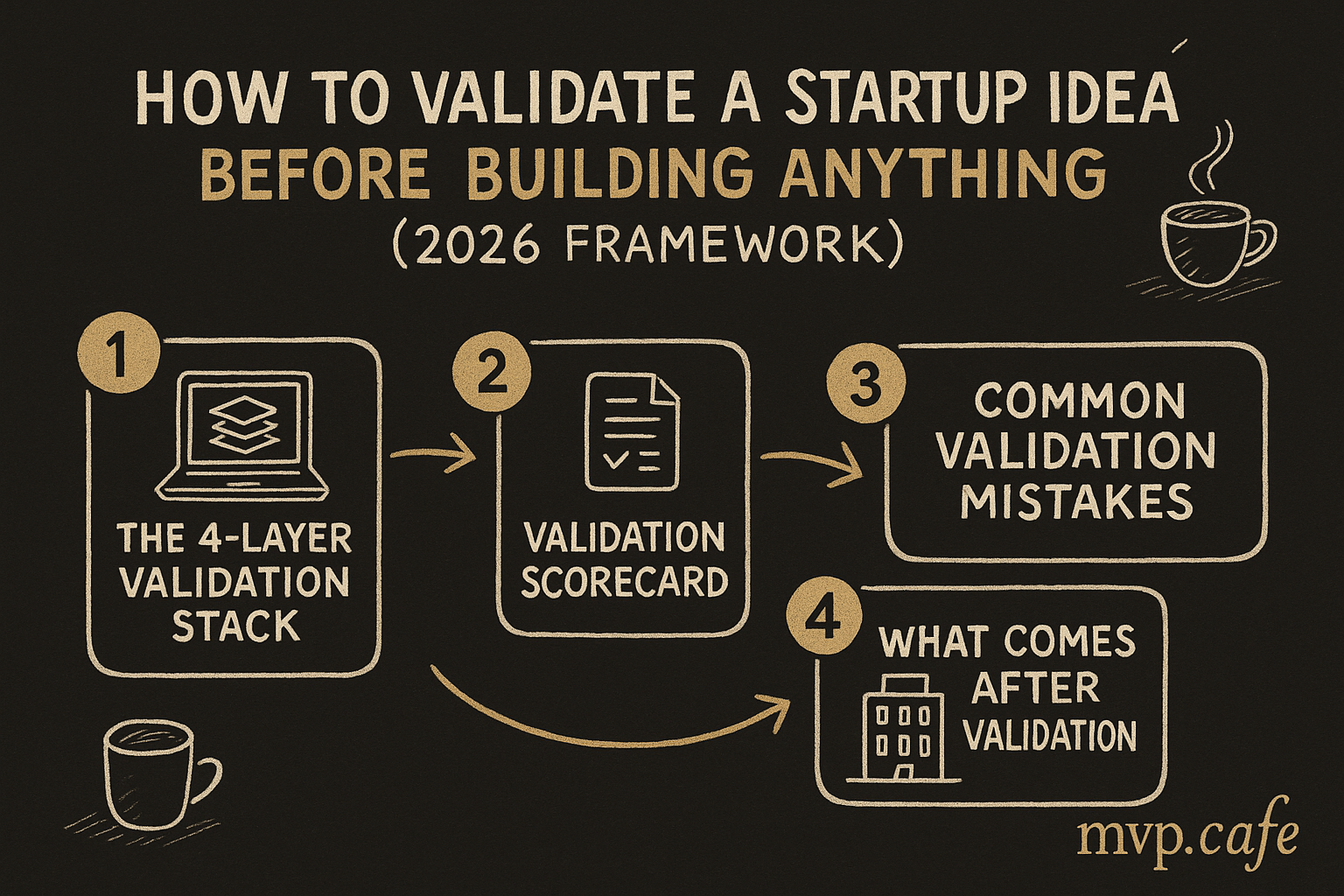
The 4-Layer Validation Stack
Most validation frameworks stop at “talk to users.” That’s layer one. There are three more.
Layer 1: Problem Validation (Week 1)
Goal: Prove the problem exists AND people actively spend money/time trying to solve it.
How:
- Find 20 people who match your target user. Not friends. Not family. Strangers who have the problem.
- Ask 5 questions, then shut up:
- “What’s the most annoying part of [problem area]?”
- “What do you currently do to deal with it?”
- “How much time/money does that cost you?”
- “What have you tried that didn’t work?”
- “If I could solve this tomorrow, what would you pay?”
- Kill signal: If fewer than 8 out of 20 describe the problem without you prompting them, the problem isn’t painful enough.
Real example: When we built the solid waste management system for Ulhasnagar Municipality, we didn’t start with tech. We rode along with garbage trucks for a week. The problem was visible — missed pickups, no tracking, citizen complaints going nowhere. We didn’t have to convince anyone the problem was real.
Layer 2: Solution Validation (Week 2)
Goal: Prove YOUR approach is better than what exists.
The competitor test:
- List every alternative (including “doing nothing” and “Excel spreadsheet”)
- For each, write down: what it costs, what it’s missing, why people still use it despite the gaps
- Your solution must be 10x better on ONE dimension, not 2x better on five
The “would you switch?” test:
- Show your target users the competitor landscape
- Ask: “What would make you switch from [current solution]?”
- If they say “nothing, it works fine” — you don’t have a business
Kill signal: If you can’t articulate why someone would switch from their current solution in one sentence, you don’t have a value proposition.
Layer 3: Willingness to Pay (Week 3)
Goal: Prove people will open their wallets, not just their mouths.
This is where 90% of validation frameworks fail. They collect “that sounds cool!” and call it validation.
The smoke test:
- Build a landing page. One page. Headline, 3 bullets, price, and a “Buy Now” button
- The button doesn’t need to process payment — it can go to a “we’re launching soon, enter your email” page
- Drive 200-500 people to it (Reddit, LinkedIn, targeted ads — ₹5,000 should do it)
- Measure click-through on the buy button
The benchmark:
- Less than 1% click → pricing or positioning problem
- 1-3% click → promising, iterate on messaging
- 3%+ click → strong signal, build the MVP
Real example: When we considered building Infew (gamification marketing SaaS), we built a landing page first. Traffic was fine. Click-through was terrible. COVID hit, timing was wrong. We saved months of build time by testing willingness to pay first.
Layer 4: Channel Validation (Week 4)
Goal: Prove you can reach these people repeatedly and affordably.
This is the layer founders skip most. You can have a great product that nobody discovers.
Test three channels, one week each:
- Pick three distribution channels (LinkedIn organic, Google Ads, Reddit, cold email, partnerships, etc.)
- Spend ₹5,000 and 10 hours on each
- Measure: cost per landing page visit, cost per sign-up intent
Kill signal: If your customer acquisition cost exceeds 30% of first-year revenue per customer, the channel doesn’t work for your price point.
The distribution question most founders avoid: “How will my 100th customer find me?” Not your first 10 (those are friends and network). Your 100th. If you don’t have an answer, you don’t have a business — you have a side project.
The Validation Scorecard
After 4 weeks, score yourself:
| Dimension | Strong Signal ✅ | Weak Signal ⚠️ | Kill Signal 🔴 |
|---|---|---|---|
| Problem | 8+ out of 20 describe it unprompted | 4-7 describe it | Fewer than 4 |
| Solution | Clear 10x advantage on one dimension | Marginal improvement | No clear advantage |
| Willingness to Pay | 3%+ buy-button clicks | 1-3% clicks | Less than 1% |
| Distribution | CAC < 30% of first-year LTV | CAC at 30-50% | CAC > 50% |
3-4 strong signals: Build the MVP. You’ve earned it.
2 strong, 2 weak: Iterate on the weak areas for 2 more weeks before building.
Any kill signals: Pivot. No amount of great code fixes a bad market.
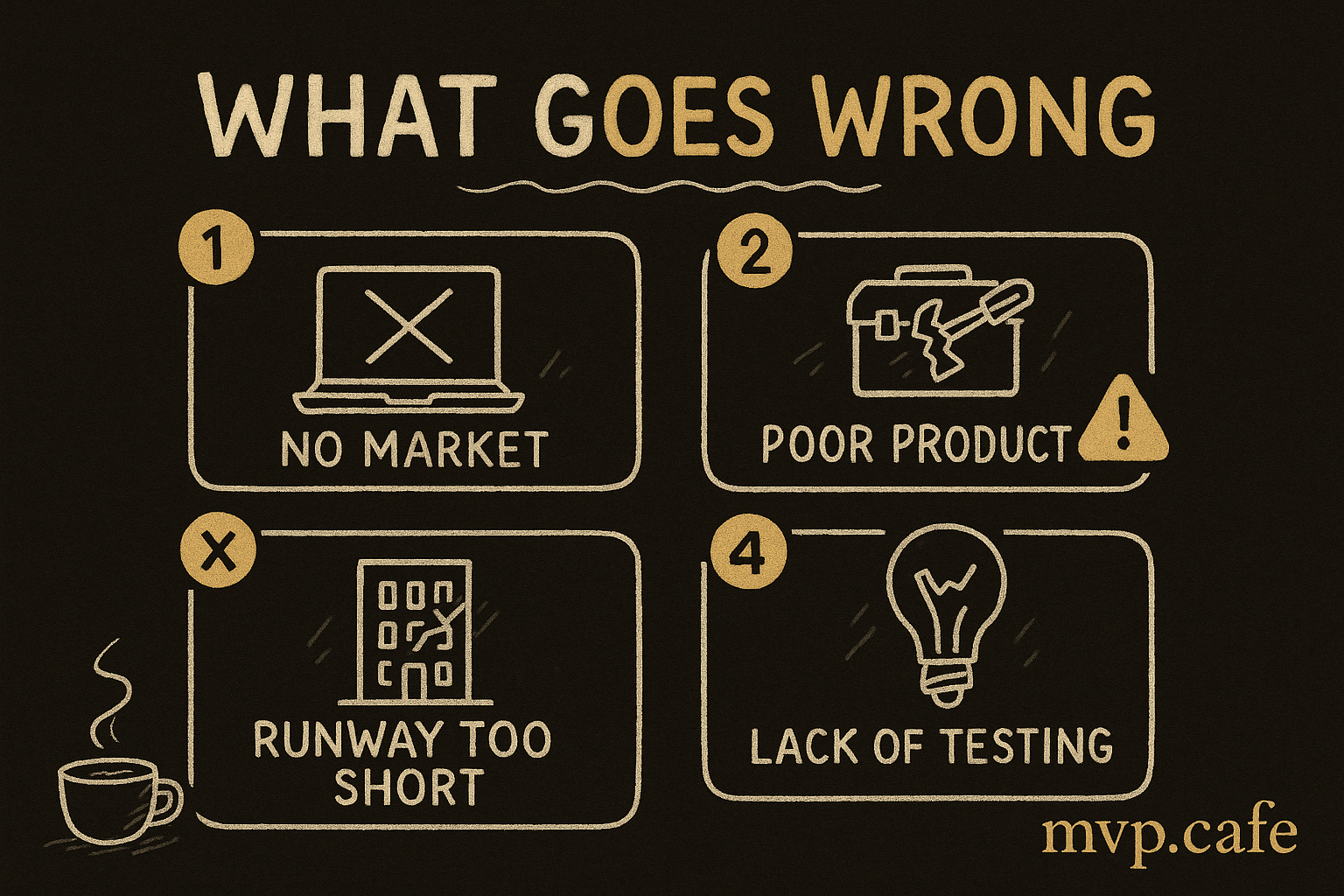
Common Validation Mistakes
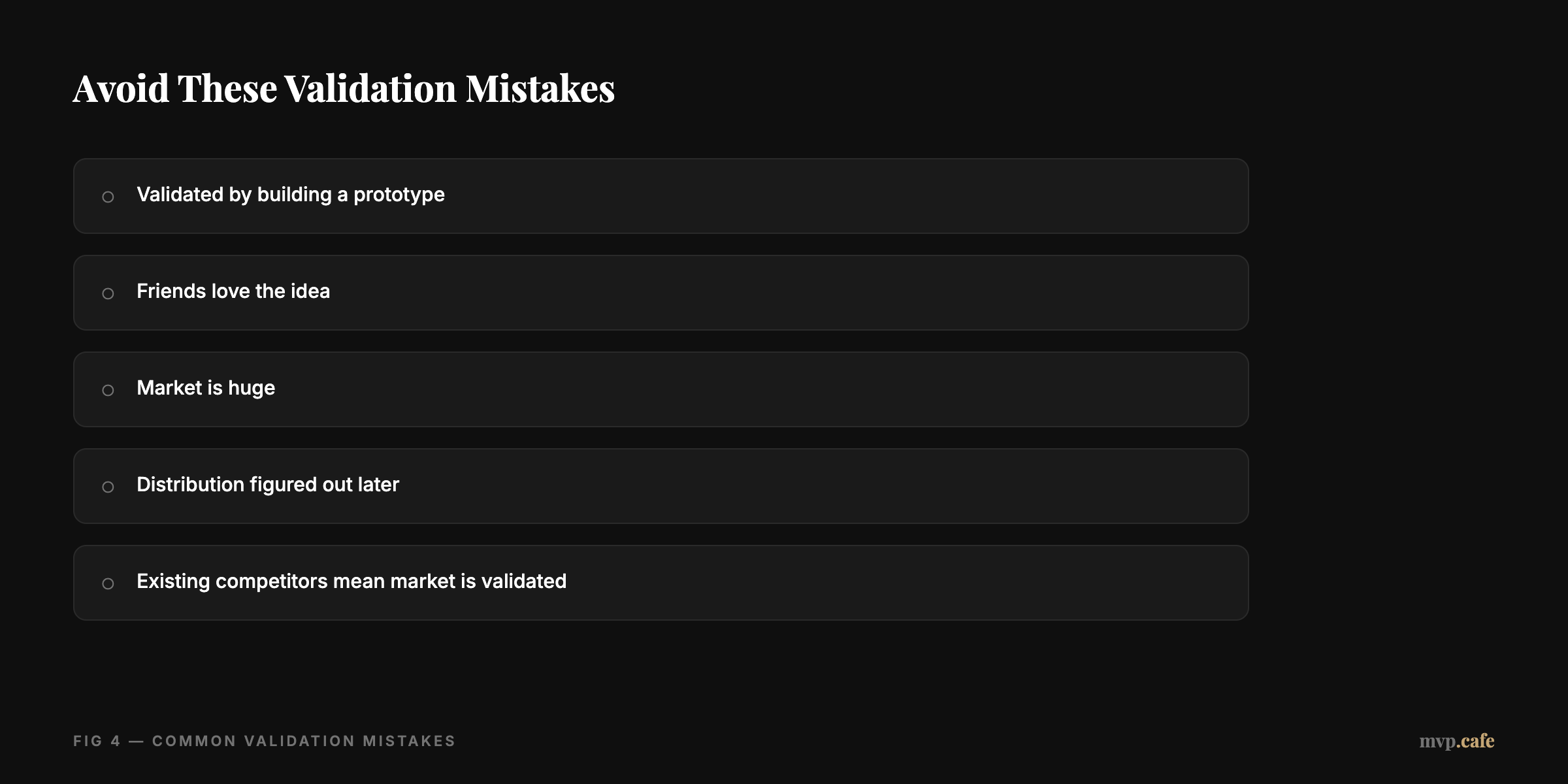
1. “I validated by building a prototype” No. That’s building. Validation comes before building. If you’re writing code to validate, you skipped straight to the expensive step.
2. “My friends love it” Your friends love you. They’ll say anything is great. Talk to strangers who have no social incentive to be nice.
3. “The market is huge” TAM means nothing for a startup. What matters is whether you can reach 100 paying customers in 90 days.
4. “I’ll figure out distribution later” Distribution is not a Phase 2 problem. If you can’t acquire customers before building, you can’t acquire them after building. The product doesn’t change the distribution math.
5. “Competitors exist, so the market is validated” Competitors existing validates the market. It doesn’t validate your entry into that market. If the top 3 competitors are well-funded and you have no differentiation, competitors are a kill signal, not a green light.
What Comes After Validation
If you’ve passed the 4-layer test, you know three things:
- The problem is real and painful
- Your approach is differentiated
- People will pay, and you can reach them
Now you build the MVP. Not the full product — the minimum version that tests your core assumption. That’s a different framework (and a different blog post).
If you’re sitting on an idea and want someone who’s done this 45 times to pressure-test it with you — that’s literally what our Strategy Sprint is. 90 minutes, two builders, ₹16K. We’ll tell you if it’s worth building, and if so, exactly how to start.
Or take the Build Score — free, 3 minutes, no email required. It’ll tell you where you stand.