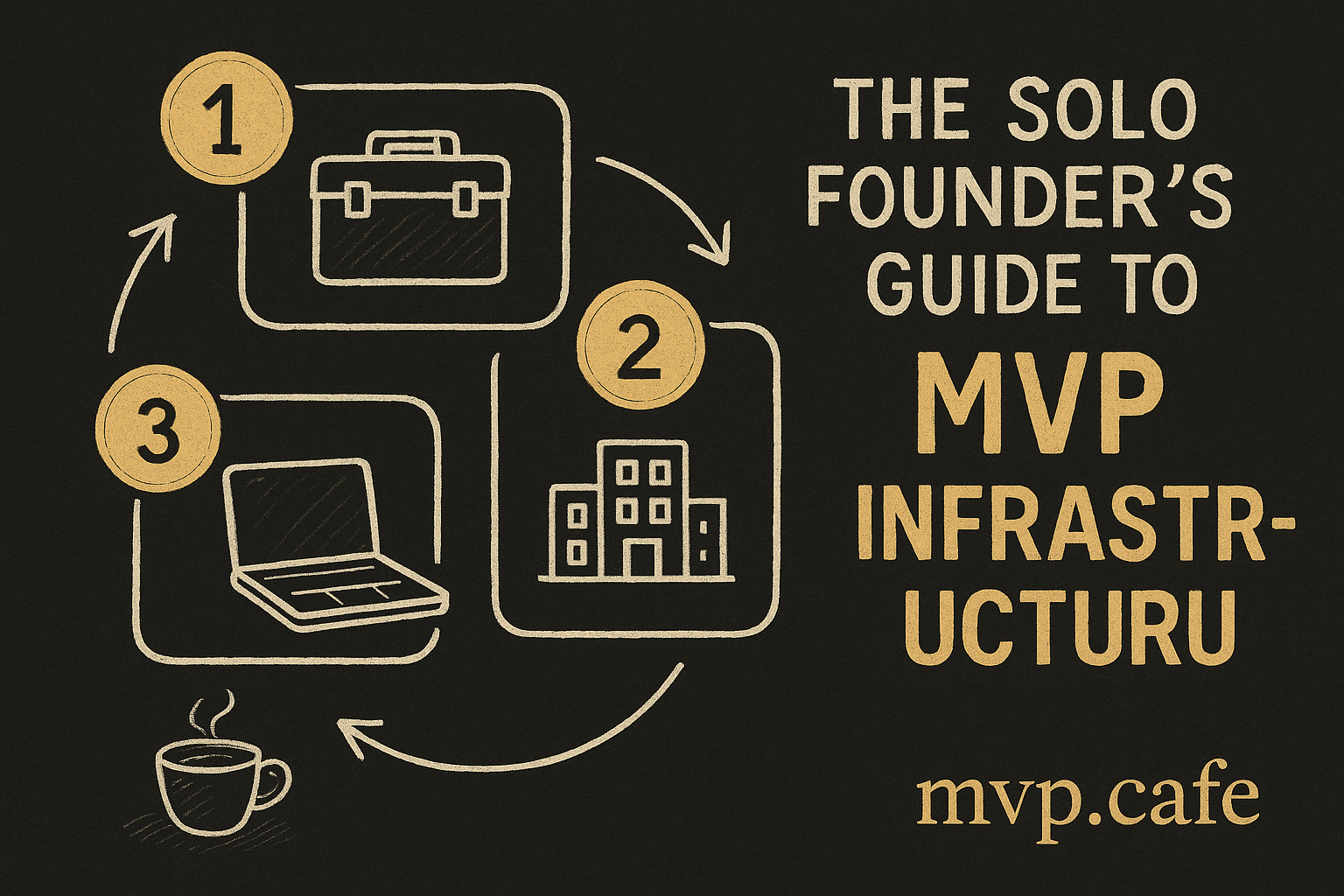
title: "The Solo Founder's Guide to MVP Infrastructure: Mastering Docker, CI/CD, and Deployment Pipelines"
description: "Leverage Docker, CI/CD, and deployment pipelines for efficient MVP infrastructure. A guide for non-technical solo founders."
pubDate: 2026-05-12
author: Aman Jha
image: /images/mvp-infrastructure-guide.jpg
ogImage: /images/mvp-infrastructure-guide-og.jpg
template: tool-post
tags: [MVP, Infrastructure, Solo Founder, Docker, CI/CD, Deployment Pipelines]
keywords: [MVP infrastructure, Docker for MVP development, CI/CD for solo founders, deployment pipelines basics, cost-effective MVP infrastructure]
targetICP: solo
draft: false
faq:
  - question: "What is MVP infrastructure?"
    answer: "MVP infrastructure is the foundational technology stack that supports the development and deployment of a Minimum Viable Product."
  - question: "How can solo founders use Docker?"
    answer: "Docker allows solo founders to create isolated environments for testing and deploying applications, simplifying development."
  - question: "What is the role of CI/CD in MVP development?"
    answer: "CI/CD automates the integration and deployment process, ensuring rapid and reliable delivery of MVP updates."
  - question: "How do deployment pipelines work?"
    answer: "Deployment pipelines automate the stages from code integration to production, ensuring smooth and error-free deployments."
  - question: "What are common mistakes in MVP infrastructure?"
    answer: "Common mistakes include overcomplicating infrastructure, ignoring scalability, and underestimating deployment needs."
---

## Understanding MVP Infrastructure

MVP infrastructure is your product's backbone during development. It's not just about making something that works; it's about creating something that can evolve and expand. For solo founders, it's not a technical hurdle—it's a business essential.


<figure>
  <img src="/blog/inline/the-solo-founders-guide-to-mvp-infrastructure-doc/fig-01-framework.png" alt="The core framework" />
  <figcaption>The core framework</figcaption>
</figure>

So, what's this MVP infrastructure all about? It's the mix of tools and processes that let you build, test, and deploy your MVP efficiently. Think of it as the sturdy foundation for your MVP journey. Docker, CI/CD, and deployment pipelines are your main tools here.

**Why does this matter for solo founders?** Because these tools let you function like a mini-team. With the right setup, you can operate like a squad of ten, even if it's just you.

Docker, for instance, packages your app and its dependencies into a "container," ensuring it runs consistently, no matter where you deploy it. CI/CD automates testing and deployment, saving you time and reducing errors. Deployment pipelines smooth out the journey from code to production, ensuring your updates are rapid and reliable.

Ready to refine your approach before jumping in? Check out our [strategy refinement service](/services/clarity).

[INLINE IMAGE: framework — Visual framework of MVP infrastructure components]

## Docker for MVP Development

Docker is a game-changer for solo founders. It’s like having a Swiss Army knife for your MVP—simplifying the dev process and ensuring consistency across environments.


<figure>
  <img src="/blog/inline/the-solo-founders-guide-to-mvp-infrastructure-doc/fig-02-failure-modes.png" alt="Common failure modes" />
  <figcaption>Common failure modes</figcaption>
</figure>

**What role does Docker play in MVP development?** In simple terms, Docker allows you to create containers. These containers package your app with everything it needs—libraries, system tools, settings—into a single neat bundle. This means your app behaves the same on your laptop as it does on a server.

**Benefits?** Loads. Docker eliminates "it works on my machine" issues by ensuring consistent environments. It cuts down resource use by sharing the OS kernel, and it speeds up deployment by removing the need to configure multiple environments.

At ZYOD, we used Docker to manage the intricacies of IoT devices, ensuring smooth deployments across over 700 machines. The result? We brought down the fabric cycle from 23 days to under 7.

For more practical insights, check out our [ZeoAuto case study](/case-studies/zeoauto).


## CI/CD for Solo Founders

CI/CD might sound like a buzzword, but for solo founders, it's a lifeline. It handles the boring stuff, so you can focus on the core—building your product.


<figure>
  <img src="/blog/inline/the-solo-founders-guide-to-mvp-infrastructure-doc/fig-03-before-after.png" alt="Before vs after" />
  <figcaption>Before vs after</figcaption>
</figure>

**So, what is CI/CD?** It's about automating code integration and the deployment process. CI (Continuous Integration) ensures code changes integrate smoothly, while CD (Continuous Deployment) automatically pushes these changes into production.

For solo founders, this means less manual work and fewer errors. Imagine deploying updates without the hassle of manual testing or the worry of breaking something.

I've seen CI/CD's impact firsthand. In a small startup, it transformed our workflow. We went from weekly updates to daily, and error rates plummeted.

For strategic insights on how to blend CI/CD with Agile methodologies, visit our [Agile success blog post](/blog/embracing-agile-for-startup-success).

[INLINE IMAGE: data-viz — Flowchart of a simple CI/CD process]

## Basics of Deployment Pipelines

Understanding deployment pipelines is like knowing the route to your destination. It ensures your product reaches users without any hiccups.


<figure>
  <img src="/blog/inline/the-solo-founders-guide-to-mvp-infrastructure-doc/fig-04-checklist.png" alt="Action checklist" />
  <figcaption>Action checklist</figcaption>
</figure>

**So, what are deployment pipelines?** They're a series of automated steps that move code from development to production. This includes building, testing, and deploying your code. Think of it as an assembly line for your software.

Setting up a deployment pipeline involves several steps: defining stages, automating tests, and ensuring rollback mechanisms for failures. The benefits are clear—faster releases, fewer bugs, happier users.

However, challenges like integration complexity and tool selection can trip you up. But with a solid plan, these can be mitigated.

Need help with a full MVP build? Consider our [MVP build service](/services/works).


## Avoiding Common MVP Infrastructure Mistakes

Even the best tools can't prevent mistakes entirely. But knowing what to watch out for can save you headaches.

**Common mistakes?** Overcomplicating your infrastructure, ignoring scalability from the start, and underestimating deployment needs. These can lead to bloated costs and delayed launches.

To avoid these, start simple, plan for growth, and prioritize your deployment strategy. Lessons from ZeoAuto taught us that a lean infrastructure can be more effective than a complex one.

For strategy refinement to avoid these pitfalls, visit our [strategy service](/services/clarity).


## Building a Cost-Effective MVP Infrastructure

Building a strong infrastructure doesn't mean burning cash. It's about smart decisions and strategic investments.

**Budgeting for MVP infrastructure** is crucial. Prioritize essential tools and services, and be wary of shiny new tech that doesn't add value. Use open-source solutions when possible and scale as you grow.

Cost-saving tips? Use cloud services for scalability without upfront investment. Automate processes to reduce manual work. And always track your expenses to avoid overruns.

Solo founders can build a powerful MVP infrastructure without breaking the bank. Check out our [budget-friendly MVP build options](/services/works).

[INLINE IMAGE: bar-chart — Cost comparison between traditional and modern MVP infrastructure tools]

## Steps to Implementing Your MVP Infrastructure

You've got the tools; now let's make them work for you.

**Step-by-step guide:** Start with planning—identify your needs and set goals. Choose the right tools (Docker, CI/CD, etc.) and set up your environment. Automate processes and test thoroughly. Finally, deploy with confidence.

You'll need resources like cloud platforms, CI/CD tools, and container services. And when things get complicated, don't hesitate to seek professional help.

For full implementation support, explore our [MVP services](/services/works).

[INLINE IMAGE: checklist — Step-by-step implementation guide]

Building an MVP infrastructure isn't just a tech task; it's a strategic move that can position your product for success. By mastering Docker, CI/CD, and deployment pipelines, you're setting yourself up to not just build a product, but to build it right.
Frequently Asked Questions
What is MVP infrastructure?
Define MVP infrastructure and its components.
How can solo founders use Docker?
Explain Docker's benefits for solo founders.
What is the role of CI/CD in MVP development?
Describe how CI/CD enhances MVP development efficiency.
How do deployment pipelines work?
Outline the process and importance of deployment pipelines.
What are common mistakes in MVP infrastructure?
List and explain common mistakes and how to avoid them.