Founder experience · Aman Jha at ZYOD
ZYOD portfolioZYOD / JOB WORK & STYLE COSTING
What does it cost to make this garment?
Tracking the materials used in each production job and how their quantities and costs add up for a style.
ROLE
Head of Product, Tech & Design
CONTEXT
Product leadership with the ZYOD team
FOCUS
Material transformation · Linked jobs · Style cost
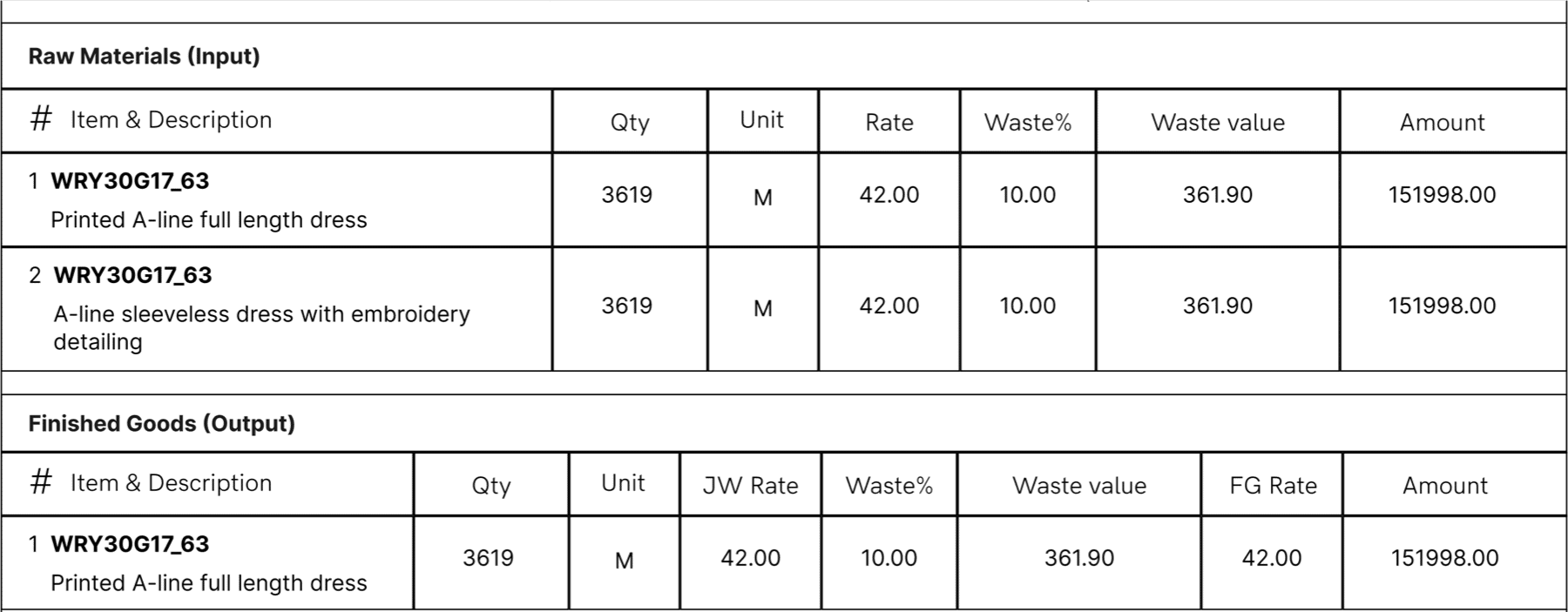
Job-work export · Input materials and finished outputs with quantities, units, rates and waste fields.
01 / THE PRODUCT PROBLEM
Follow the material as it changes.
In garment production, a job can consume materials and produce a new material or finished item. That output can become the input to another job.
For each job, the system needs to record what went in, what came out, the quantities and the cost.
FROM THE FACTORY FLOOR TO YOUR WORKFLOW
Trying to connect work and costs?
Share the process and tools you use today. We’ll discuss a scope for the information your team needs.
02 / RECORD MATERIALS AND WORK
Record what goes in and comes out.
01
Material in
Select the materials consumed by the operation.
Identity · Quantity · Unit · Rate
02
Work applied
Record the job-work rate and the waste fields for the operation.
Job rate · Waste · Amount
03
Material out
Create the resulting material or finished item for the next step.
Output identity · Quantity · Finished-goods rate
03 / LINK THE OPERATIONS
The output becomes the next input.
The output of one job can feed the next. Linking them lets the team trace a garment back through the materials and operations that produced it.
01
Dyeing
02
Printing
03
Cutting
04
Stitching
05
Finishing
06
Packaging
An example sequence based on the style-progress report. Each style follows the production steps it needs.
04 / SEE THE COST OF A STYLE
See the cost of each production stage.
The style-progress report lists raw-material orders, production jobs, quantities and costs. A summary shows the style’s totals, with the job detail available underneath.
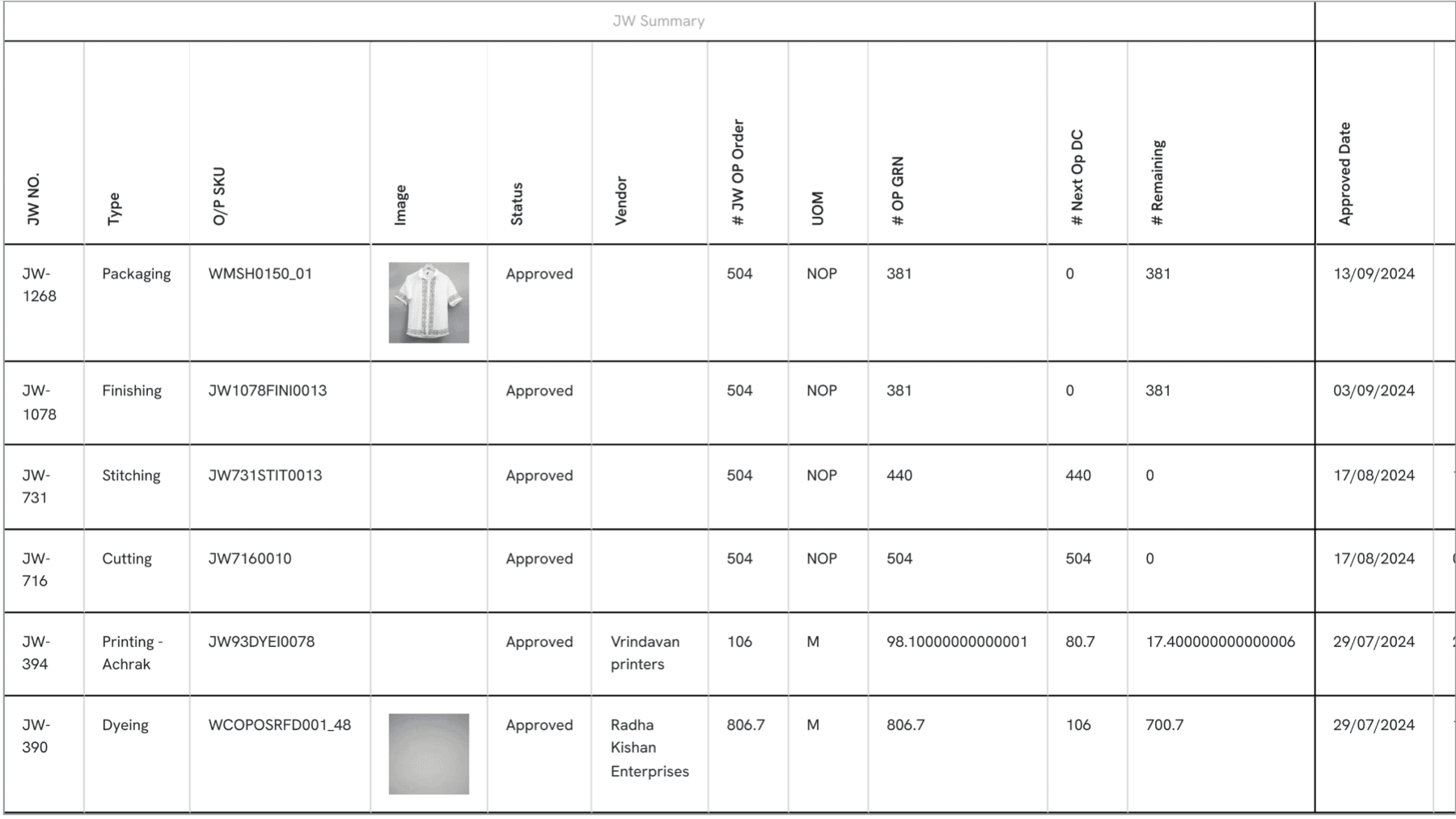
Style WMSH0150_01 · Linked job-work stages, quantities, material identities and dates.

The same report’s order and cost summary. The report and job-work export above are separate source records.
05 / CHECK THE COST DETAILS
Keep the details behind the totals.
01
Always show the unit.
Each job records the material, quantity and unit for its inputs and outputs.
02
Link new materials to their source.
When a job creates a new material, its record stays linked to the inputs and work that produced it.
03
Keep the job detail close.
The summary sits beside the material and job records so a reviewer can check where the costs came from.
MY ROLE / WITH THE ZYOD TEAM
My role with the ZYOD team.
As Head of Product, Tech & Design, I led the organisation behind ZYOD’s ERP and factory applications. This work connected production records, material movements and cost reporting within the broader manufacturing platform.
Follow the garment onto the factory floor.
See how garment labels link inspections and repairs to a shared quality dashboard.
ZYOD portfolio ZYOD portfolioFROM THE FACTORY FLOOR TO YOUR WORKFLOW
Let’s look at your workflow.
Send a short enquiry. We’ll reply by email to discuss the scope before any work starts.